That tight, heavy feeling at the base of the skull after an hour of scrolling. Getting neck pain treatment in Sydney is one of the most common reasons patients walk through the doors at Spine and Posture Care in Sydney CBD.
With Australians spending an average of 5.5 hours on their phones every day, the spine absorbs more forward load than at any other point in history. This guide explains exactly what tech neck is, why it keeps coming back, and what actually fixes it beyond stretching and taking breaks.
What Is Tech Neck?
Tech neck is a repetitive stress condition caused by holding the head in a forward and downward position for extended periods while using a phone, tablet, laptop, or computer. The term covers a range of symptoms from neck stiffness and shoulder tension through to headaches, arm numbness, and referred pain further down the spine.
It is not a new injury in the traditional sense. There is no single moment of damage. Tech neck develops through accumulated load on the cervical spine over weeks and months of repeated posture patterns, and that accumulated load is what makes it harder to resolve with simple stretches alone.
What Causes Tech Neck?
The human head weighs approximately 5.5 kilograms in a neutral, upright position. Every 15 degrees the head tilts forward, the effective load on the cervical spine increases by 6.5 to 7 kilograms. At 45 degrees of forward tilt, the typical angle for looking down at a phone, the neck is managing over 20 kilograms of force.
Now apply that across a 5.5-hour daily average. The cervical spine absorbs that elevated load for the equivalent of a full working day, every day. The joints, ligaments, and muscles supporting the neck are not designed for that pattern of sustained stress.
The deeper issue is that this posture does not just compress the neck. It pulls the head forward of the body’s centre of gravity, shifting the entire load-bearing pattern of the spine. Understanding the full range of neck pain causes helps explain why tech neck can produce symptoms well beyond the neck itself.
Symptoms of Tech Neck
Tech neck produces a range of symptoms that vary in intensity depending on how long the condition has been developing. Common presentations seen at Spine and Posture Care include:
- Neck stiffness that is worse in the morning or at the end of a screen-heavy day
- Aching or sharp pain at the base of the skull or across the shoulders
- Tension or tightness across the upper trapezius and between the shoulder blades
- Headaches originating at the base of the skull and radiating forward
- Numbness, tingling, or weakness in the arms and hands
- A persistent feeling of heaviness in the head
- Mid and lower back pain from compensatory postural changes
- Pain that worsens after long periods of sitting or commuting
The last two points are consistently underreported. Most patients present focused on the neck and shoulders, unaware that the mid-back aching and lower back fatigue they experience are part of the same postural pattern.

How Tech Neck Affects Your Posture
Forward head posture is the postural signature of tech neck. For every centimetre the head shifts forward of the shoulders, the load on the cervical spine increases significantly. Over time, the deep neck flexor muscles, which hold the head in proper alignment, weaken through disuse. The upper trapezius and neck extensors compensate by working harder, creating the persistent tightness most patients describe.
As the head moves forward, the shoulders follow. The thoracic spine rounds, the chest tightens, and the lower back either flattens or hyperextends to compensate for the shifted centre of gravity. What begins as a neck issue becomes a full-spinal postural pattern.
Posture correction at Spine and Posture Care addresses the entire chain, not just the symptomatic area. Treating the neck in isolation without addressing the thoracic and lumbar compensation patterns is one of the reasons many patients see only partial or temporary improvement elsewhere.
Tech Neck and Headaches: The Connection Most People Miss
The link between tech neck and headaches is one of the most clinically significant aspects of the condition and the least discussed in general health content. The upper cervical joints, specifically C1, C2, and C3, share a nerve pathway with the trigeminal nerve, which supplies sensation to the head and face. Restriction or irritation in these joints produces referred pain that travels forward to the forehead, temples, and behind the eyes.
This is called a cervicogenic headache. It is not a tension headache in the conventional sense and it does not respond to the same treatments. Patients who take pain relief for what they believe are tension headaches often find only temporary relief, because the source of the pain is joint restriction in the upper cervical spine, not muscular tension in the scalp.
For Sydney CBD desk workers and commuters who experience frequent headaches alongside neck stiffness, a cervical assessment is the appropriate first step. Treating the joint restriction directly is what produces lasting change.
Why Tech Neck Gets Worse Over Time
There is an important distinction between acute tech neck and chronic tech neck that no competitor blog addresses clearly.
Acute tech neck is the stiffness and soreness that follows a heavy screen day. Rest, movement, and stretching can resolve it within 24 to 48 hours. Most people experience this and dismiss it as normal.
Chronic tech neck develops when the same postural load is repeated daily over months without being addressed. The deep neck flexor muscles progressively weaken. The cervical joints develop restricted movement patterns. The surrounding ligaments adapt to the forward head position, making it structurally harder to return to neutral. Stretching becomes less effective because the problem is now structural, not just muscular.
The lower back is also affected at this stage. The compensatory postural pattern that begins in the neck eventually loads the lumbar spine differently, contributing to the lower back pain from sitting pattern that is extremely common in Sydney CBD office workers.
5 Ways to Reduce Tech Neck at Home
These strategies reduce the daily load on the cervical spine and slow the progression of tech neck. They will not reverse structural changes but they are important as part of any management plan.
- Raise the screen to eye level. The single most effective postural change. Holding a phone at eye level eliminates the forward tilt angle almost entirely. For desk workers, a monitor or laptop stand that aligns the top of the screen with eye height removes the constant downward gaze.
- Take movement breaks every 45 minutes. Sustained static posture is more fatiguing than dynamic movement. Standing, walking, or doing a brief cervical retraction exercise every 45 minutes breaks the load pattern before it accumulates.
- Practice chin tucks daily. A chin tuck, where the chin draws straight back to create a double chin, activates the deep neck flexors that weaken through forward head posture. Ten repetitions, three times per day, targets the exact muscle group that tech neck progressively shuts down.
- Set screen time limits for high-risk apps. Social media scrolling produces the most sustained downward head position of any screen activity. Awareness tools built into iOS and Android can cap daily time on high-usage apps and reduce total cervical load.
- Address the thoracic spine. Tech neck is not only a cervical problem. Thoracic mobility work, including chest openers, thoracic extensions over a foam roller, and seated rotation exercises, reduces the rounding that drives the forward head position in the first place. For more on how posture habits develop and how to reverse them, the guide on correcting posture as an adult covers the full process.
Self-Management vs. Professional Care
| Factor | Self-Management | Chiropractic Care at Spine and Posture Care |
|---|---|---|
| Target | Muscular tension and postural habits | Specific restricted cervical joints identified through assessment |
| Relief duration | Hours to days for acute symptoms | Structural improvement accumulates across sessions |
| Addresses deep neck flexor weakness | Partially, through exercises | Yes: assessed and prescribed specifically |
| Addresses cervical joint restriction | No | Yes: targeted adjustment to restricted segments |
| Addresses thoracic compensation | Partially, with mobility work | Yes: full spinal assessment included |
| Identifies cervicogenic headache source | No | Yes: upper cervical assessment included |
| Assessment beforehand | None | Full postural, neurological, and spinal assessment |
| Suitable for chronic tech neck | Limited | Yes: appropriate for both acute and chronic presentations |
How Spine and Posture Care Treats Tech Neck
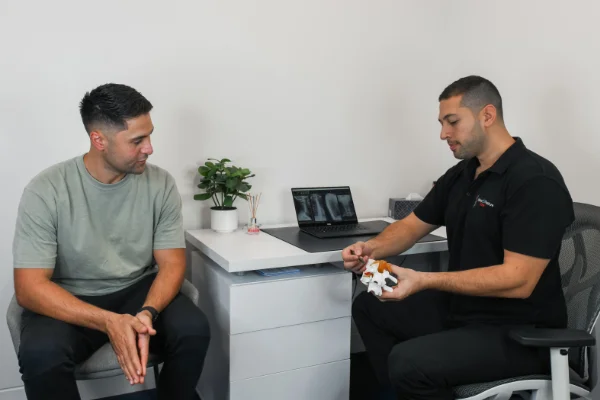
The neck pain treatment in Sydney process at Spine and Posture Care begins with a thorough assessment before any treatment is applied. The first visit covers case history, postural analysis, cervical range of motion testing, and orthopaedic assessment to identify which joints are restricted, which muscles have weakened, and which compensatory patterns have developed in the thoracic and lumbar spine.
Treatment varies by presentation. For most tech neck patients, it combines specific chiropractic adjustments to restricted cervical and thoracic segments, soft tissue work to the upper trapezius and suboccipital muscles, and a prescribed home exercise programme targeting deep neck flexor strengthening. Patients presenting with cervicogenic headaches receive additional upper cervical assessment focused on C1 to C3.
Progress is reviewed at each visit. The goal is not ongoing passive treatment. It is restoring normal joint function, rebuilding the muscular support system, and giving patients the tools to manage screen load independently.
Conclusion
Tech neck is not a minor inconvenience that resolves with a weekend away from screens. For the majority of Sydney CBD workers spending 5 to 8 hours daily on devices, it is a cumulative structural problem that worsens progressively without the right intervention. The symptoms, including neck stiffness, shoulder tension, headaches, and arm referral, are the end result of months of compressive load on a spine that never gets the chance to fully recover.
Spine and Posture Care works with tech neck patients across Sydney CBD who have tried stretching, ergonomic adjustments, and pain relief without lasting results. Identifying the specific cervical joints that have lost normal movement, rebuilding the deep neck flexor strength that sustained screen use depletes, and correcting the thoracic compensation pattern is what produces change that holds. For anyone whose neck symptoms extend to the lower back, the related guide on lower back pain from sitting explains how the two conditions are connected.
Ready to Get Started? Stop managing tech neck one stretch at a time. Spine and Posture Care is available at Macquarie Street and Barangaroo Avenue in Sydney CBD. Call +61 2 8040 9922 or book a neck assessment today.
Frequently Asked Questions
What is the difference between a tech neck and a regular stiff neck?
A regular stiff neck follows a single event like sleeping awkwardly or a sudden movement. Tech neck is a repetitive stress condition from sustained forward head posture. It returns consistently and worsens over time without treating the structural cause.
Can tech neck cause headaches?
Yes. Restriction in the upper cervical joints refers pain forward through the trigeminal nerve pathway, producing cervicogenic headaches. These are distinct from tension headaches and do not fully resolve with pain medication alone.
How long does tech neck take to resolve with chiropractic care?
Acute tech neck often improves within three to six sessions. Chronic cases with joint restriction and muscle weakness developed over months typically need eight to twelve sessions plus a consistent home exercise programme.
Is tech neck covered by private health insurance in Australia?
Most Australian extras policies include chiropractic care covering tech neck treatment. Rebate amounts vary by fund and tier. Medicare does not cover standard consultations. A receipt is provided after every visit for direct fund submission.
Can desk workers in Sydney CBD prevent tech neck from returning after treatment?
Yes. Raised screen height, regular movement breaks, daily deep neck flexor exercises, and periodic chiropractic check-ins are the most effective combination. Patients who maintain the home exercise programme consistently report significantly fewer recurrences.
The post Tech Neck: Why Your Neck Hurts After Scrolling on Your Phone appeared first on Spine and Posture Care.
from Spine and Posture Care https://ift.tt/fUC9dNF
via IFTTT



No comments:
Post a Comment