lower back pain treatment in Sydney is one of the most searched health topics among desk workers in the CBD. Spine and Posture Care sees this presentation every week. A person sits at a desk for six, eight, sometimes ten hours. The lower back tightens. Standing up brings a sharp ache. By Friday it is affecting sleep. This guide explains exactly why sitting causes lower back pain, how to identify the likely cause, and what actually helps.
Why Does Sitting Cause Lower Back Pain?
Most people assume sitting is a neutral, low-stress position for the spine. It is not. Research consistently shows that sitting increases pressure on the lumbar discs by 40 percent compared to standing. The lower back loses its natural inward curve when seated without support. This shifts load from the vertebrae onto the discs and surrounding soft tissue.
What Happens to the Lumbar Spine When You Sit
The lumbar spine has five vertebrae, L1 through L5. Between each vertebra sits an intervertebral disc that absorbs load and maintains spacing between the bones. In a neutral standing position, these discs share load evenly. In a seated position, particularly a slouched one, the posterior disc wall takes on significantly more pressure.
The erector spinae muscles that support the spine fatigue within thirty to sixty minutes of sustained sitting. Once these muscles fatigue, the load transfers directly onto the discs and facet joints. This is why lower back pain from sitting tends to worsen as the day progresses.
Why Long Hours at a Desk Make It Worse
Sydney CBD desk workers face compounding risk factors. Hot desking means workstations change daily, making consistent ergonomic setup difficult. Laptop use on low surfaces forces the lumbar spine into sustained flexion. Long commutes on trains or buses add further unbroken sitting time before and after an already sedentary workday.
The psoas muscle, which connects the lumbar spine to the hip, shortens with prolonged sitting. A tight psoas pulls the lumbar vertebrae forward and increases compression. This is one of the most overlooked contributors to desk-related lower back pain and one of the first structures assessed at Spine and Posture Care.
Common Causes of Lower Back Pain From Sitting
Sitting does not cause one single type of lower back pain. The structure being loaded or irritated determines the type of pain, its location, and what makes it better or worse. According to healthdirect, lower back pain is one of the most common musculoskeletal complaints in Australia, affecting eight in ten people at some point.
Muscle Strain and Tension
Muscle strain is the most common cause of lower back pain in desk workers. The erector spinae and surrounding lumbar muscles hold the spine upright. When they fatigue from sustained sitting, they develop micro-tension and trigger points that produce a dull, persistent ache.
This type of pain typically eases with movement and worsens after long periods of stillness. It is usually felt across both sides of the lower back. Morning stiffness that loosens within thirty minutes is a classic sign of muscular involvement.
Disc Irritation or Bulging Disc
The intervertebral discs between L1 and L5 are under the greatest pressure during seated flexion. Sustained or repeated loading can cause the disc to bulge outward, pressing on nearby nerve tissue. A bulging disc in the lumbar spine often produces a sharp, localised pain that intensifies when moving from sitting to standing.
Disc-related pain tends to be one-sided and can refer into the buttock or upper thigh. It does not always produce leg symptoms. Pain that is sharp on standing but eases once upright for a few minutes is a common disc presentation.
Sciatica
Sciatica occurs when the sciatic nerve is compressed or irritated, most often at the L4-L5 or L5-S1 level. Prolonged sitting places direct pressure on the nerve root and can trigger or aggravate lumbar radiculopathy. The result is pain, tingling, or numbness that travels from the lower back through the buttock and down one leg.
Sitting on hard surfaces for extended periods is a known sciatica trigger. For a detailed breakdown of recovery, the guide on how long does sciatica last covers timelines and what to expect at each stage.
Poor Posture and Postural Syndrome
Postural syndrome develops when the spine is held in a sustained, non-neutral position over months or years. The joints, muscles, and connective tissue adapt to that position. Over time, returning to a neutral posture becomes uncomfortable. Posture correction addresses both the structural adaptation and the muscle imbalances that reinforce poor sitting habits.
This type of pain is position-dependent. It is present during or after sitting and absent during movement or rest. It is extremely common in Sydney CBD office workers and typically responds well to chiropractic care combined with workstation changes.

How to Tell What Is Causing the Pain
No two presentations of lower back pain are the same. The symptom pattern, location, and behaviour of the pain provide strong clinical clues about the underlying cause. The table below is designed to help desk workers identify the most likely source before seeking assessment.
| Symptom Pattern | Likely Cause | Suggested Action |
|---|---|---|
| Dull ache that eases with movement | Muscle strain or postural tension | Movement breaks and posture correction |
| Sharp pain when standing from seated | Disc irritation or bulging disc | Clinical assessment recommended |
| Pain with tingling or numbness down the leg | Sciatica or nerve compression | Prompt chiropractic assessment |
| Stiffness across the lower back after long sitting | Facet joint restriction | Spinal adjustment and mobility work |
| Pain only on one side of the lower back | Muscle imbalance or disc issue | Assessment to confirm cause |
This table is a guide only. Overlapping symptoms are common, and multiple structures can be involved at the same time. A clinical assessment at Spine and Posture Care identifies the primary driver and guides treatment accordingly.
What Makes Lower Back Pain From Sitting Worse
Certain habits and environmental factors significantly increase the load on the lumbar spine. Awareness of these is the first step toward reducing daily aggravation.
Sustained sitting without movement breaks is the most consistent aggravator. Research points to thirty to sixty minutes as the threshold at which disc pressure and muscle fatigue begin to compound. Sydney commuters who sit on public transport for forty minutes, then sit at a desk all day, often exceed four or more hours of unbroken sitting before lunch.
Laptop use at low surfaces is a significant and underrecognised factor. Low laptop placement forces the lumbar spine into flexion while simultaneously straining the neck and upper back. For desk workers already managing tech neck, this creates a full-spine postural load. The guide on tech neck and upper back pain covers the neck component of this pattern in detail.
Chair height is also frequently overlooked. A seat that is too low places the hips below the knees, increasing lumbar flexion. A seat that is too high places excessive load on the sitting bones and tightens the hip flexors. Neither position allows the lumbar spine to maintain its natural curve for sustained periods.
What to Do at Home to Relieve Lower Back Pain From Sitting
Home management is effective for muscular lower back pain. It is less effective for disc or nerve-related presentations, which require clinical assessment.
Movement breaks are the single most effective intervention for desk workers. Standing and walking for two to three minutes every thirty to forty-five minutes reduces disc pressure and reactivates the lumbar stabilisers. Setting a recurring timer is the most practical way to implement this consistently.
Hip flexor stretching addresses the tightened psoas that builds up from prolonged sitting. A kneeling hip flexor stretch held for thirty to forty-five seconds on each side, performed twice daily, progressively lengthens the muscle and reduces forward pull on the lumbar spine.
Core stability work supports the lumbar spine by reducing the load the discs and joints must absorb. Dead bugs, bird dogs, and glute bridges are three exercises that build lumbar stability without placing the spine in high-load positions. These are frequently prescribed as part of a care plan at Spine and Posture Care.
Lumbar support during sitting helps maintain the natural curve and reduces disc pressure. A rolled towel or a dedicated lumbar cushion placed at the small of the back is a simple, low-cost option for desk workers who cannot access an ergonomic chair.
When Home Remedies Are Not Enough
Home management has clear limits. When lower back pain from sitting persists beyond two to three weeks, worsens despite rest and movement changes, or includes nerve symptoms such as leg pain, tingling, or numbness, professional assessment is the appropriate next step.
Disc and nerve-related presentations do not resolve with stretching or posture changes alone. Untreated disc irritation can progress to herniation. Untreated nerve compression can lead to lasting sensory changes. Early assessment identifies the cause before the condition becomes more complex to manage.
How a Chiropractor Treats Lower Back Pain From Sitting
Chiropractic care for lower back pain from sitting focuses on three things: identifying the specific structure causing the pain, restoring normal joint movement, and addressing the contributing postural and muscular factors.
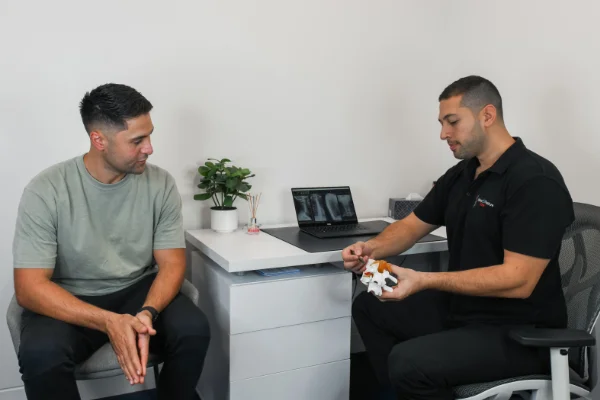
The initial clinical assessment at Spine and Posture Care includes a full history of the pain pattern, postural analysis, orthopaedic and neurological testing, and range of motion assessment. This determines whether the pain is muscular, disc-related, facet joint-related, or nerve-related before any treatment is applied.
Spinal adjustment is used to restore movement to restricted facet joints in the lumbar spine. Joint mobilisation addresses stiffness in segments that have adapted to sustained flexion. Soft tissue therapy targets the erector spinae, psoas, and gluteal muscles that tighten with prolonged sitting. AHPRA-registered chiropractors at Spine and Posture Care combine these approaches with a tailored care plan that includes workstation guidance and home exercise.
The goal of care is not only to reduce pain but to address the biomechanical pattern that produced it. A desk worker who leaves with only pain relief and no postural or movement changes will typically see the same presentation return within weeks.
Conclusion
Lower back pain from sitting is not an inevitable part of desk work. It is a predictable biomechanical response to sustained lumbar loading, and in most cases it is highly treatable. The cause, whether muscular, disc-related, facet joint, or nerve-related, determines the correct approach. Identifying the cause early produces faster, more complete recovery.
Spine and Posture Care sees lower back pain from sitting as one of the most common presentations among Sydney CBD workers. The clinic’s approach combines accurate clinical assessment with evidence-based chiropractic care and practical workstation guidance. For desk workers ready to move from managing pain to resolving it, a professional assessment is the clearest next step.
Frequently Asked Questions
Why does my lower back hurt when sitting but not standing?
Sitting increases lumbar disc pressure by 40 percent. The spine loses its natural curve, loading the discs and fatiguing the support muscles. Standing redistributes that load and reactivates the stabilisers.
How do I know if it is a disc problem or muscle tightness?
Muscle pain is a dull bilateral ache that eases with movement. Disc pain is sharper, often one-sided, and worsens when standing from seated. A clinical assessment confirms the cause.
Can sitting all day cause sciatica?
Yes. Prolonged sitting compresses the lumbar nerve roots at L4-L5 and L5-S1. This can trigger or worsen sciatica, producing pain, tingling, or numbness down one leg.
Is chiropractic for lower back pain covered by private health in Sydney?
Most Australian extras policies cover chiropractic care. Spine and Posture Care processes HICAPS claims on the spot. Check annual limits and waiting periods with the individual fund.
What happens at the first appointment at Spine and Posture Care?
The chiropractor takes a full case history, runs postural and orthopaedic testing, identifies the cause, and outlines a tailored care plan. Treatment can begin on the same visit.
The post Why Your Lower Back Hurts When You Sit (And What to Do About It) appeared first on Spine and Posture Care.
from Spine and Posture Care https://ift.tt/xGtMAeP
via IFTTT



No comments:
Post a Comment